Introduction
Humanity is producing more digital data than existing storage systems were designed to preserve. Scientific datasets, legal records, medical histories, satellite imagery, cultural archives, AI training corpora, model checkpoints, and enterprise logs are growing at a scale where conventional storage media—hard disks, SSDs, and magnetic tape—face limits in density, energy use, durability, and long-term maintenance. IDC projected the global datasphere to reach 175 zettabytes by 2025, showing the magnitude of the storage challenge. (Seagate)
DNA-based digital data storage is an emerging technology that proposes a radically different idea: instead of storing information as magnetic states or electronic charges, we store it as sequences of the four DNA bases—A, C, G, and T. DNA is nature’s oldest information storage system, and synthetic DNA can, in principle, preserve digital information at extremely high density for decades, centuries, or even longer under suitable conditions.
What is DNA-based digital data storage?
DNA-based digital data storage is the process of converting digital files—text, images, videos, databases, source code, AI models, or scientific datasets—into DNA sequences. A normal computer file is represented using binary digits, 0s and 1s. In DNA storage, this binary information is encoded into combinations of the four DNA letters: adenine, cytosine, guanine, and thymine, commonly written as A, C, G, and T. (Twist Bioscience)
This does not mean storing data inside a living organism. Most modern DNA storage research uses synthetic DNA, created in laboratories and stored in non-living, controlled formats such as tubes, capsules, dry powder, or specialized cartridges. The DNA acts as a molecular archive, not as a biological organism.
How does it work?
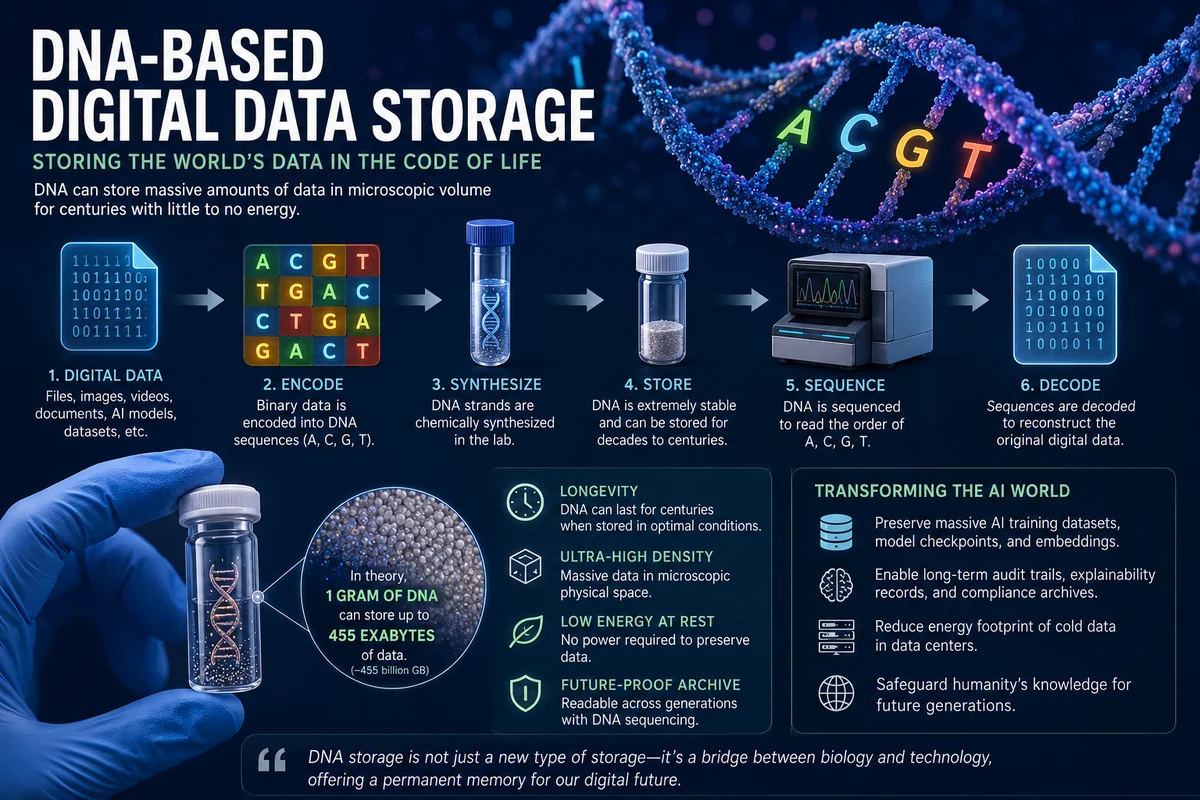
The process has six main stages.
First, the digital file is converted into binary form. Then an encoding algorithm maps that binary sequence into DNA letters. The encoding must avoid problematic biological patterns, such as very long repeats or highly unbalanced base compositions, because these can make DNA synthesis and sequencing error-prone.
Second, the encoded DNA sequence is divided into many short fragments, often called oligonucleotides or oligos. Each fragment carries part of the data and usually includes an index or address so that the original file can be reconstructed later. Twist Bioscience describes this process as converting 0s and 1s into A, C, T, and G sequences, synthesizing them in short segments, storing them, sequencing them, and decoding them back into the original file. (twistbioscience.com)
Third, the DNA is chemically synthesized. This is the “write” step, and it is currently the most expensive and difficult part of DNA storage. (Nature)
Fourth, the DNA is physically stored. Because DNA is extremely compact, a very large amount of information can fit into a tiny physical volume. George Church, Yuan Gao, and Sriram Kosuri reported that, at the theoretical maximum, DNA can encode two bits per nucleotide, corresponding to about 455 exabytes per gram of single-stranded DNA.
Fifth, when the data is needed, the DNA is sequenced. Sequencing is the “read” step: machines read the order of A, C, G, and T letters.
Finally, a decoding algorithm reconstructs the original digital file using indexes, redundancy, and error-correction codes. This is necessary because DNA synthesis, amplification, storage, and sequencing can introduce insertions, deletions, substitutions, and missing fragments.
Why do we need DNA storage?
The main motivation is long-term archival storage. Not all data needs to be accessed every second. Some data is “cold”: it is rarely accessed but must be preserved reliably for decades. Examples include legal records, medical records, scientific experiments, climate data, cultural heritage archives, national records, enterprise compliance data, and AI training datasets.
Traditional storage systems require active maintenance. Hard drives fail, SSDs wear out, magnetic tape must be migrated periodically, and all of them require physical infrastructure, energy, cooling, and hardware refresh cycles. DNA, by contrast, offers extremely high density and potentially very long durability. Goldman et al. described DNA as attractive for long-term archiving because of its high-density encoding capacity, longevity, and low-maintenance potential. (Nature)
The need is especially urgent in the AI era. AI systems are not only compute-intensive; they are also data-intensive. Training data, benchmark datasets, model checkpoints, embeddings, logs, safety evaluations, synthetic datasets, and audit trails are becoming critical digital assets. The International Energy Agency estimated data-center electricity consumption at around 415 TWh in 2024 and projected it could reach around 945 TWh by 2030 in its base case, with AI-accelerated servers contributing significantly to future growth. (IEA)
DNA storage will not replace GPUs, RAM, SSDs, or fast databases. Its strongest role is likely to be as an ultra-dense, low-energy, long-term archival layer.
How expensive is DNA storage?
At present, DNA storage is still expensive compared with hard disks, SSDs, and magnetic tape. The main cost is DNA synthesis—the process of writing digital information into DNA molecules. Sequencing costs have fallen dramatically over the past two decades, but writing custom DNA at massive scale remains a bottleneck.
Earlier work by Goldman et al. estimated costs of about $12,400 per MB for writing and $220 per MB for reading using the technologies available at that time. (PMC) More recent cost discussions show improvement, but DNA storage is still not priced like normal cloud storage. A 2025 synthesis cost survey reported array oligo prices in the range of roughly $0.00001 to $0.001 per base, though such estimates vary by technology, scale, quality, and supplier. (synthesis)
Research is actively attacking this cost problem. For example, a Nature Communications study showed that lower-cost, high-error photolithographic DNA synthesis can still enable reliable storage if combined with strong reconstruction and error-correction algorithms. The authors identified synthesis cost and speed as the central bottleneck and argued that cheaper, high-throughput synthesis could make DNA storage more practical. (Nature)
So the current answer is clear: DNA storage is technically possible, but not yet economically competitive for general-purpose storage. It is most realistic today for high-value, long-term, rarely accessed archival data.
What phase is the technology in?
DNA storage has moved beyond pure theory, but it is not yet a mainstream storage product.
The field has already demonstrated several important milestones. In 2012, Church, Gao, and Kosuri encoded a book into DNA. (PubMed) In 2013, Goldman et al. encoded and accurately recovered multiple digital files, including text, audio, and images. (Nature) In 2017, the DNA Fountain architecture showed robust and efficient DNA storage, storing files such as an operating system and a movie and retrieving them successfully. (PubMed) In 2018, Organick et al. demonstrated random access at larger scale by storing over 200 MB across more than 13 million DNA oligonucleotides and retrieving individual files without needing to read the entire pool. (Nature)
The field has also reached early automation. Microsoft and the University of Washington demonstrated a fully automated end-to-end DNA storage system that encoded and retrieved the word “hello,” an important step toward moving DNA storage from manual laboratory workflows toward data-center-compatible systems. (Source)
Commercialization is now emerging, but it remains early. The DNA Data Storage Alliance published a 2025 technology review describing commercial-readiness metrics and remaining challenges. (SNIA | Experts on Data) Atlas Data Storage has announced the Atlas Eon 100 as an early scalable DNA storage offering aimed at archival use cases, while Biomemory is developing DNA storage appliances for data-center environments and describes its technology as a new tier for high-value, long-term cold data. (PR Newswire)
Therefore, DNA storage is best described as being in the advanced research, prototype, and early commercial pilot phase.
Why is DNA storage significant?
DNA storage is significant because it attacks several problems at once.
It offers extreme density. Tiny amounts of DNA can theoretically store vast amounts of information, far beyond conventional magnetic and optical media.
It offers longevity. DNA can remain readable for very long periods when stored properly, which makes it attractive for long-term preservation. (Nature)
It has low energy-at-rest potential. Once DNA is synthesized and safely stored, it does not require constant power in the same way active data-center infrastructure does.
It may remain readable across technological generations. Even if today’s hardware becomes obsolete, DNA sequencing is likely to remain scientifically and commercially important because DNA is fundamental to biology.
It also creates a bridge between computing, synthetic biology, information theory, storage systems, and AI infrastructure.
How could DNA storage revolutionize the AI world?
DNA storage could transform AI infrastructure, but mainly in the archival layer rather than the real-time compute layer.
First, it could preserve massive AI training datasets. Large models depend on enormous datasets, and future AI governance may require datasets to be auditable, reproducible, and preserved. DNA storage could become a secure cold archive for training corpora, benchmark datasets, and legally sensitive data.
Second, it could preserve model checkpoints and AI histories. As models evolve, organizations may need to retain old versions for compliance, safety analysis, rollback, research reproducibility, and forensic investigation. DNA storage could support long-term model preservation.
Third, it could help with AI safety and explainability archives. For high-stakes domains such as healthcare, law, finance, and government, organizations may need to preserve logs, decision traces, evaluation reports, and explainability datasets for many years. Atlas explicitly lists AI explainability datastores among potential enterprise archival assets. (PR Newswire)
Fourth, it could reduce the physical and energy footprint of cold AI data. As AI data centers grow, energy consumption and infrastructure constraints are becoming serious concerns. DNA storage would not reduce the energy needed for training or inference, but it could reduce the burden of long-term inactive storage. (IEA)
Fifth, in the longer term, DNA storage may enable molecular search and computation. Microsoft and the University of Washington have explored molecular techniques for searching and retrieving data without fully converting everything back into electronic form. (Source) Biomemory also suggests that future molecular systems may support search and compute capabilities as the technology matures. (biomemory.com)
Key challenges
Despite its promise, DNA storage faces major challenges.
The first challenge is cost. DNA synthesis must become dramatically cheaper for large-scale deployment.
The second challenge is write speed. Today’s DNA writing processes are far slower than electronic storage.
The third challenge is read latency. Sequencing and decoding take time, so DNA storage is not suitable for frequently accessed data.
The fourth challenge is error management. DNA storage systems must handle synthesis errors, sequencing errors, molecule degradation, missing strands, contamination, and sampling bias.
The fifth challenge is standardization. For DNA archives to be useful over decades, future systems must understand how the data was encoded. This is why groups such as the DNA Data Storage Alliance and SNIA are working on specifications, codecs, and commercial-readiness metrics. (DNA Storage Alliance)
The sixth challenge is integration with existing IT systems. Enterprises will not adopt DNA storage unless it works with familiar storage interfaces, security models, APIs, metadata systems, and compliance workflows. Biomemory, for example, states that it is working on data-center-compatible DNA storage systems with interoperable APIs and an S3-style object storage interface. (biomemory.com)
Near-term use cases
The most realistic near-term use cases are not everyday laptops or mobile phones. They are high-value cold archives, such as:
- Scientific datasets
- Climate data
- Space mission data
- Cultural heritage
- National records
- Legal archives
- Medical research datasets
- Enterprise compliance records
- AI training datasets
- Model checkpoints
- Critical backups
These are datasets where the value of long-term preservation may justify the high initial writing cost.
Conclusion
DNA-based digital data storage is one of the most exciting long-term storage technologies being explored today. It is not a replacement for SSDs, GPUs, cloud databases, or magnetic tape in the immediate future. Instead, it should be viewed as a possible new archival tier: extremely dense, durable, low-energy at rest, and suitable for preserving humanity’s most valuable digital information.
For the AI world, DNA storage could become especially important. AI is creating and consuming unprecedented volumes of data. Future AI systems will need not only more compute, but also better long-term memory: datasets, models, provenance records, audit trails, and explainability archives. DNA storage offers a futuristic but scientifically credible path toward preserving that memory for decades or centuries.
The technology is still expensive and slow, but the direction is clear. If DNA synthesis becomes cheap, automated, standardized, and data-center-friendly, DNA storage could become one of the foundational technologies of the next archival computing era.
References
- Church, Gao, and Kosuri, “Next-generation digital information storage in DNA,” Science, 2012. (PubMed)
- Goldman et al., “Towards practical, high-capacity, low-maintenance information storage in synthesized DNA,” Nature, 2013. (Nature)
- Erlich and Zielinski, “DNA Fountain enables a robust and efficient storage architecture,” Science, 2017. (PubMed)
- Organick et al., “Random access in large-scale DNA data storage,” Nature Biotechnology, 2018. (Nature)
- Microsoft and University of Washington automated DNA storage demonstration, 2019. (Source)
- DNA Data Storage Alliance / SNIA publications and 2025 technology review. (DNA Storage Alliance)
- Twist Bioscience overview of digital DNA data storage workflow. (twistbioscience.com)
- Antkowiak et al., “Low cost DNA data storage using photolithographic synthesis and advanced information reconstruction and error correction,” Nature Communications, 2020. (Nature)
- International Energy Agency, “Energy demand from AI,” data-center electricity projections. (IEA)
- Atlas Data Storage and Biomemory commercial DNA storage developments. (PR Newswire)